Spiral Q Peoplehood and Participatory Puppet Performance, Part 3

image

(Jump here for Part 1 and Part 2)

How it is created and why that matters

In Confronting the Challenges of Participatory Culture: Media Education for the 21st Century, Henry Jenkins writes that “[p]articipatory culture shifts the focus of literacy from individual expression to community involvement.” Peoplehood, as an event that seeks to involve a community/ies expression of itself/themselves through parades and pageantry, is an interesting context to explore participatory culture and its potential. The lens of participatory culture is also useful to look at Peoplehood in order to understand its creation process and why it matters.
image

A participatory culture was originally defined by Jenkins as one:

  1. With relatively low barriers to artistic expression and civic engagement
  2. With strong support for creating and sharing one’s creations with others
  3. With some type of informal mentorship whereby what is known by the most experienced is passed along to novices
  4. Where members believe that their contributions matter
  5. Where members feel some degree of social connection with one another (at least they care what other people think about what they have created)

Researching participatory cultures over time – through fan communities and activists movements primarily – Jenkins and Sangita Shresthova have been interrogating the possibilities and challenges through the Civic Imagination Project where “imagining community … is actively generating new cultural symbols to describe their relationship with each other. Imagination is seen not as a product or a possession … Rather, we talk about imagining as a process.”

image

Supporting imagining as a process and creating new signs and symbols through sharing stories are core ideas of the Spiral Q Puppet Theater. Through low-stakes and accessible object creation and performance, participants can make and remix their everyday reality alongside others. In its mission statement, Spiral Q states that “We imagine a city whose streets reflect the full spectrum of its residents’ creativity. We see a responsive and engaged society that rallies consistently to overcome the challenges of discrimination and oppression. We envision a world of abundance that mobilizes its resources to nurture shared vitality.” When sharing the power of the 2019 Peoplehood Parade and Pageant, co-director Jennifer Turnbull describes the process that surfaced the story and related puppets:

This year we partnered with three local grassroots activist groups …. Through pageantry we were able to show the through line connection they all had to health, housing, self determination and freedom.

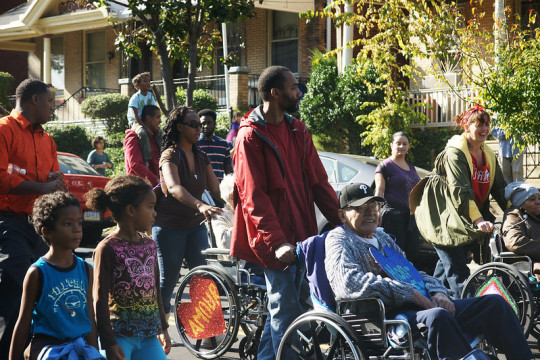
In working to design for shared power and participation, Tracy Broyles – the Director of the Q after Matty – describes the ways that affirmation, imagination and practice are so important. Everyone has a role to play, she says, and that “any moment someone enters the process is the right moment” (TEDx Philly, 2012). Affirming participation, and providing many points of entry, are key ways that the Q attempts to build Peoplehood and, according to Jenkins, are defining features of participatory practice.
image

Another central element of participation, according to Jenkins, “is that we participate in something larger than ourselves, however we want to imagine what it is we are participating within” (Jenkins, Confessions of a Aca-Fan post, 2019). Eli Nixon, in 2003, describes themselves and this work as part of a larger whole:

I’m just a small column of flesh and bones. I can build something that’s larger than me… I really get a kick out of it as a way to tell stories and to make humans bigger than they are or to examine different parts of everyday people’s lives in a way that I think is more interesting than real life. It’s an awesome way to interpret who we are.

Looking at the outcomes of a participatory process is another way to assess its viability (Jenkins, Confessions of a Aca-Fan post, 2019). Tracy describes the ways that people literally “spiral out of q.” 

What we see is this a place where people test these things and then go out into the world. Okay so now [they] might not use puppets and art and all these things … but they have got this place, a sense of direction, a sense of safety, a sense of community has formed around that individual or that community and then that cause or idea … can really gain some traction and go off and become a movement that’s working on a policy level or at a community organizing level or simply building beautiful things.
image

In working to refine a definition of participatory culture in a fractured media environment, Jenkins and his colleagues bring a critical focus to the mix, ie. “Which members of a dis-privileged group find their power position strengthened through the participatory process?” A complex question but also critical for the Q. In one example, we find an interview 2003 with Jennifer Hilinski, a therapist at Girard Medical Center, who was asked about her experience working with a group of men in recovery in collaborating with the Q on Peoplehood the previous fall. 

“The common story was about recovery and getting back into the real world as contributing members of society.” Jennifer said, “And they took a theme of going from hell — which was the streets and using — to this kind of angelic transformation and re-entering the world and the streets but not as street person” (2003). Since that time a group from Girard Medical Center participate in Peoplehood every year, leading with their giant backpack puppets of transformation.
image

Conclusion

In the 2008 Peoplehood newsletter, the process of building Peoplehood is described by Tracy as “flawed, just like our democracy.” And we are reminded by the Civic Imagination Project that “If stories can inspire and empower social change, stories can also shatter communities, feeding our fears and suspicions, re-enforcing stereotypes in particularly vivid ways.” Jenkins and his colleague also tell us that the fostering of participation is vital while fragile and requiring care:

participation could also be finished. It could come to an end. Democracy, as a political and social practice, is not a given, but could cease to exist. … This is why participation and democracy need to be actively protected, and not just silently appreciated.

We know that object performance, storytelling, or even parades and pageants which historically have also been used in fascist and authoritarian settings, do not create democratic space themselves. Instead democracy, through an ethos of participation, needs to be fostered.

Peoplehood, as a creative space for democratic storytelling and cultural remixing, is one such opportunity to intentionally test and tinker with the possibilities and challenges of participatory practice. It allows individuals and groups to come together, figure out what is needed when they work together, and then bring it into being through object creation, puppet performance and joyful demonstration.

In 2003, Matty Hart described Peoplehood’s parade and pageant as “secular cultural ritual[s] … that are actually really kind of sacred and really really old.” These rituals, when built in shared and participatory ways, situate puppets and objects as powerful vehicles for fostering civic imagination through the creation of new cultural symbols and understandings. 

As Jennifer writes about the Q in a Nonprofit Executive Leadership Institute
newsletter: “we create space for the unknown. You just don’t know what you don’t know.”

image

Want to read more about Peoplehood and Spiral Q? Check out Part 1: What is Peoplehood? and Part 2: Elements of Performance.

Images courtesy of spiralq.org and my personal collection.

Spiral Q Peoplehood and Participatory Puppet Performance, Part 2

image

(Jump here for Part 1 and Part 3)

Elements of the Performance 

The Peoplehood Parade and Pageant has shifted and morphed overtime to respond to its community and context and yet, both the parade and pageant retain many of the elements of their performance from the beginning. 

image

Since 2000, the Peoplehood Parade has kicked off at the Paul Robeson House. The house is part of the West Philadelphia Cultural Alliance and it provides access to the arts, supports local artists, and advocates for arts to promote social change and economic development. The website describes their work and mission in relation to Paul Robeson’s legacy: 

In a red brick house – not unlike many others on the 4900 block of Walnut Street in Philadelphia – Paul Robeson came to live out his final years with his big sister Marian Forsythe. The unassuming rowhouse was a haven for a man who had used his voice in song and speeches to advocate for the rights of oppressed people. 

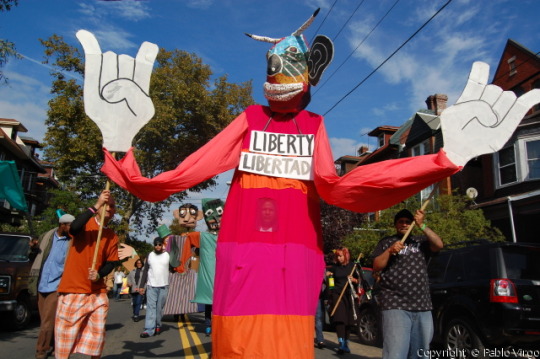
Every Peoplehood starts on the block between Walnut and Sansom and Fran Aulston, of the Robeson House (and now her successor), welcome all to the neighborhood and give a blessing for the parade’s journey. From there the parade moves south, wending its way through residential streets. A few people carry a banner and a couple of flags to lead the parade, followed by different groups carrying or wearing puppets, costumes, flags, and their own banners. The giant puppets are spread out among the paraders with arms outstretched. The West Powelton Stepper Drum Squad, and sometimes its dancers, have been partners for many years and hold the front of the parade, while other musical groups – often a handmade instrument brigade – take up the rear. 

image

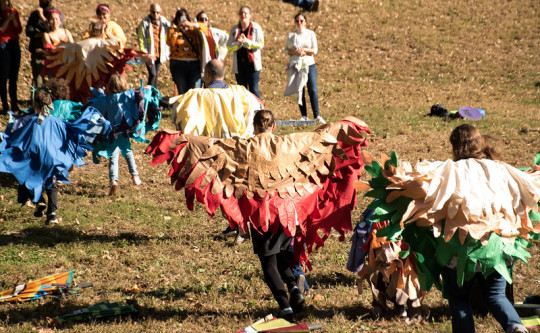
The parade ends at Clark Park, a municipal park created in the late 1800s whose prominent feature is a former pond now known as the “bowl”. Peoplehood enters this park from its most southwest corner. Everyone is invited to cross the bowl and sit around its edge while organizers actively recruit people who might be interested in participating. Open roles usually include at least birds, houses, and flags; the birds and houses are made to fit smaller people so that children can be involved. 

image

The pageant itself is performed in the bowl for, and partially by, the audience. Over the years the details of the story have shifted but the arc of the story remains essentially the same — there are people, animals, houses, etc. co-existing in relatively peaceful (but often separate) ways when some sort of force comes in and does damage to them and brings destruction and pain in its wake. This force is then only confronted by a counterforce of the people, animals, houses, etc. organizing themselves and using their collective power to reverse the pain and destruction. Once the power of the collective is recognized and engaged, the destructive force is reduced and then (often) included in the celebration of transformation and community at the end which is highlighted by music, dance and an invitation for everyone to join in. 

image

Although the story is similar, the puppets used and the story details are specified by
whomever creates the pageant; some puppets from previous years are used in remixed roles
and others are built new. Topics of the day bring a focus to the story; these have included
school closures, the housing market crash, gun violence in the community. Today, the pageants
continue to reflect the social and political happenings in the community and wider world, much
in the way that puppet and object performance has historically taken up this role (Bell). For
example, In 2017 the parade was organized around the theme of Healing Our Roots both as a
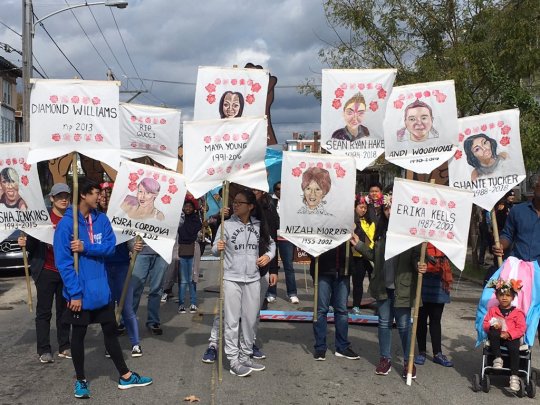
tribute to the late Fran Aulston, who had died earlier that year, as well as the emergent #blacklivesmatter movement. 2018 brought a focus on Trans Lives Matter and in 2019 three activists groups – ACT-UP, Philly Thrive (advocating for clean-up of Philly’s old oil refineries),
and the Shut Down Berks Coalition (advocating for the release of families in a Pennsylvania
migrant detention center) – were engaged through an Arts in Action Pipeline process and invited
to imagine the pageant together. 

image

The pageant is set up to feature its surrounding landscape, ie. the urban park surrounded by rowhouses, trolley cars, playgrounds, a health center and a community garden. The opening of the pageant is always a loosely choreographed event involving flags although since 2017 the pageant begins with a participatory Healing & Reconciliation Dance meant to embody the historic violence against people of color in the United States (spiralq.org). 

image

The puppet objects form the details of the narrative as they move and dance and interact with one another – a kind of cultural remix. Puppets have included creative tools like giant paintbrushes and hammers, destructive forces like bulldozers, oil rigs and eviction notices, transformational puppets such as floating ancestors, butterflies and suns, fantastical creatures that enter on rocketships and winged horses, memorial objects such as ankhs and vessels, as well as a range of janis figures that represent the related sides of struggle and addiction to acceptance and transformation. 

image

The giants puppets are usually created using simple backpack structures and require three people to carry. Giant heads and heads are created for these puppets, and/or fit onto someone’s head and/or are created to be carried, bunraku style. Headdresses and feather backpacks create simple birds, cardboard houses are worn around the torso, flags of different sizes and colors are available for waving and signaling. Other elements have included conestoria and giant crankies, painted umbrellas, cardboard clothing, and lots of painted “flat” puppets carried individually or collectively. Spoken and written text, sounds and music also play key roles in most performances. Musical partners have included various local musicians, the US Postal Service Choir, and parade partners. As Matty describes

It’s messy and it should be. And I think that those are the critical moments in how we’re trying to redefine the use of public space that allows us to understand that it is ours.

image

Want to read more about Peoplehood and Spiral Q? Check out Part 1: What is Peoplehood and a Part 3: How it is created and why that matters.

Images courtesy of spiralq.org and my personal collection.

Spiral Q Peoplehood and Participatory Puppet Performance, Part I

image

Walking in downtown Philadelphia in the late 1990s, we came upon Matty. Or, really what we saw was a giant black and red fist made of cardboard holding itself straight up in the air. My friend recognized the activist under the fist as Matty Hart and we stopped to admire the giant puppet and to say hello. I was immediately inspired and set out to find out more about Matty and what he was building. 

During the day I worked with an educational non-profit, operating from a small office connected to teachers online, and I soon found myself spending late afternoons in a walk-up apartment at 13th and Sansom streets among activists and artists, making cardboard and paper mache puppets. A couple weeks later, I jumped into a parade in Old City as one of the hands of the giant puppet that took the lead; this was my first parade with the newly formed Spiral Q Puppet Theater

Matty apparently thought I was a librarian. Or a Quaker. Admittedly I was a bit quiet and shy among the activists, and I wasn’t directly connected to any of their work. Instead, I was drawn to the making – the paper mache, the used jars of house paint, the fabric rolls, the giant puppets made from all of these materials, and the spectacle these objects created on the street. It reminded me of the organizing work I was doing with educators on then nascent Internet, although here it was in full-out analog and recycled glory. Over time I would become a regular volunteer in the Spiral Q Peoplehood Parade and Pageant, a member of the Board of Directors, and then ultimately its co-Chair and Chair, a position I would be in for several years. 

What is Peoplehood? 

image

One story of Peoplehood is about how a community was activated immediately following
a show of police-force and repression that impacted many in the city of Philadelphia in the year 2000. Another story is the power of the art of ancient object performance and puppet theater
and how, when used wisely, it can feed a fundamental need for connected community. 

John Bell’s book on American Puppet Modernism: Essays on the Material World in Performance ends with his thoughts about “the communicative powers of traditional materials performed live in public spaces” and picks up on both of these stories (Bell 229). First referring to puppet spectacles created for the 1999 protests against the World Trade Organization in Seattle, he then turns to the unjust arrest of dozens of puppeteers and the destruction of hundreds of puppets the following year: “The power of the ancient art of puppet theater was demonstrated in a different way … during the 2000 Republican National Convention in Philadelphia” (Bell 230). 

Peoplehood is a “giant puppet spectacle” envisioned as an event that brings people and organizations involved in Spiral Q programs together to celebrate across communities. Beth Pulcinella, then a “Q” teaching artist, reflects back on that period of time and the naming of “Peoplehood” in the 2008 Spiral Q Peoplehood Newsletter

That fall, after the Republican National Convention when many of us had gotten arrested, we were tired. Puppets had been built and destroyed … Fall had arrived and with fall came Spiral Q’s annual culminating giant puppet parade and pageant. It was the parade of all parades. 

She then describes the evening that it came together. After a meeting to decide on a name and vision that had ended without a satisfying conclusion, Beth recounts sitting down to peruse the dictionary trying to find new words to help describe what she and others were envisioning. 

… I can taste that night and the feeling of complete certainty when it leapt at me from the dictionary pages: “Peoplehood, n 1. The quality or state of constituting a people 2. The awareness of the underlying unit that makes the individual part of a people.” 

Based on the poster created for that year, the full title became Peoplehood: An All-City Parade & Pageant. It reads “Spiral Q’s participatory giant puppet and costume parade that will loop through West Philadelphia to Clark Park, followed by ‘The Pageant of Our Neighbors’.” The poster details the times and addresses of these two events – the parade and the pageant – and then announces “Studios open to the public to build giant puppets will be held each Saturday and Sunday in October at Spiral Q Puppet Theater, 1307 Sansom Street, from 11-5.” 


image

This call to build a participatory giant puppet and costume parade went out to the general public in addition to the Q’s many partners. This act of making invitations and engaging the community in shared practices underscores the participatory ethos of Spiral Q’s work and deeply informs the now annual Peoplehood Parade and Pageant. 

Peoplehood’s Influences

 image

ACT-UP, the AIDS Coalition to Unleash Power, was an original partner and influence of the Q from the very beginning. In exploring the power of live and material performance, Bell describes the work of ACT-UP starting in the late 1980s. He writes that “ACT-UP created brilliant actions marked by audacity, humor and good design sense, and their choice of materials was centrally important to their work” (Bell 227). He then describes their use of objects, including visual language and even the bodies of those who had died of AIDS, and the ways they were able to leverage mass media to draw attention to the urgency of the crisis and to force change. Ezra Berkeley Nepon in their book
Dazzle Camouflage: Spectacular Theatrical Strategies for Resistance and Resilience quotes ACT-UP activist Jon Greenberg in describing the power of the group’s performance methods as “theater in the world” using all the conventions of formal theater on the streets and in public spaces instead (Nepon 32). 

In an interview from the Philadelphia Gay News in May 1996, Matty tells this story of discovering puppetry when he met the Radical Fairies at a march with ACT-UP. 

I went to New York City for Stonewall 25 … I was really feeling very disenfranchised … About eight blocks into the march I just sat down. Was exhausted, and the sun was really strong. 

And then I hear all this really amazing drumming, and screaming, and bells … all of the sudden I spot these three, huge fairy puppets that were 6 feet in the air above people’s heads, with moving heads, and moving eyes, and long arms that were holding people and hugging them. They were fantastic. 

Like ACT-UP, Matty conceived of Spiral Q as a place where the tools and techniques of theater could be used by “all these people who aren’t invited into traditional theater at all.” And like the fairies he saw, he chose to use puppets. “Puppets can be this totally transcendent thing” Matty says. “For on instant, we can share some elemental delight.” When asked about the name, Matty describes the “Spiral” as an old symbol of magic, of energy and the “Q” is the queer, the other (Philadelphia Gay News 1996, Works In Progress 2002). 

Giant puppetry, and the art of Bread and Puppet, also have been a strong influence on the Q. Matty, as well as several teaching artists, spent time with Bread and Puppet in Vermont. The use of available, cheap, reused and recycled materials is a core piece of all the work at Spiral Q as is the notion of puppeting via parading in public space, and reclaiming public space through the accessible form of parade (Brother Bread, Sister Puppet). Peoplehood’s pageant is reminiscent of the Bread and Puppet pageant in key ways: it is situated in a natural amphitheater (albeit the smaller urban version); the giant puppets, as well as the collective elements, require groups of people; and, the seating of the audience and the staging bring a focus to the story as well as to the landscape of the story. 

Although called a “puppet theater” the Q has rarely produced its own shows in any traditional sense. Often compared to other public spectacles inspired by Bread and Puppet, like Heart of the Beast May Day Parade and Pageant in Minnesota, the Q’s commitment to supporting the community to use puppetry and object performance to build their own stories makes it fairly unique. A closer comparison in the theater work is Ramshackle Enterprises founded by Eli Nixon, a former Q teaching artist. On their website Eli describes what they are trying to do: 

I’m trying to find out how to teach, perform and collaborate in ways that challenge ordinary roles and oppressive power dynamics, that encourage creative resistance to the phobias and ism-hood of our culture and explore the vast potential of our strange and glorious species [and] … trying to see what termites, pelicans and lichen have to teach us. 

The Cattywampus Puppet Council in Knoxville, Tennessee and the Appalachian Puppet Pageant is another example. Their mission is similar: to utilize community-based theatre, parades, and participatory workshops to build power and creativity in community and fuel justice and liberation. Both pageants, Peoplehood and the Appalachian Puppet Pageant, are described as “people-powered” in their performance and in their creation. 

Over time, the influences on Peoplehood will continue to grow, change and evolve due to the participatory nature of its work. For example, in the mid 2000s, a process of speaking and listening to each other called “Story Circle” was adapted from the teachings and traditions of John O’Neil and Junebug Productions.

image

Want to read more about Peoplehood and Spiral Q? Here is Part 2: Elements of performance and Part 3: How it is created and why that matters.

Images from my personal collection.

Chicago International Puppet Theater Festival

This year’s Hanukkah/Christmas presents to each other were tickets to the first weekend of the Chicago International Puppet Theater Festival, which ran from Jan 17-27 2019. Neither of us had been before (this was the 3rd) and it was Jack’s first puppet festival overall.

50337804_10155826546396994_4120408958823301120_n

In anticipation, Jack ordered You, Me and the Violence by Catherine Taylor. It set the stage for puppetry being more than just socks (although socks can be cool) and underscored that the ways we chose to relate to other is powerfully connected. (Much more can be said about this essay; stay tuned.)

49897648_10155826546426994_8135720810942824448_n

We arrived in Chicago on Friday and stayed through the first weekend (this timing did mean we missed the opening show, Ajijaak on Turtle Island,  although we had already seen it in Philly and highly recommend it). We were able to see 6 shows altogether plus the first of two symposia and a late night cabaret by the multi talented Yael Rasooly. The shows included:

On the way home, I stuck a recorder between myself and Jack and started to capture some of our thoughts about our experiences. The roughness of these is therefore all my fault, just fyi.

Where next with our new-found puppet festival energy? Up to UConn next week for Living Objects: African American Puppetry Festival and Symposium.

Heroes, Neighbors and Ancestors: A Waverly Street Suitcase Puppet Show

Original suitcase puppet play created in 2010 by Christina during a suitcase puppet workshop run by Eli Nixon of Ramshackle Enterprises; performed with Beth Pulcinella. Performed here in revised draft form in summer 2018 with Jack (and Marcy) in Waverly Street Courtyard in Philadelphia. Recording by Meera Siddharth.

(Note: The wrong puppet is used at one point in this rough cut; can you find the mistake?)