

(Jump here for Part 1 and Part 2)
How it is created and why that matters
In Confronting the Challenges of Participatory Culture: Media Education for the 21st Century, Henry Jenkins writes that “[p]articipatory culture shifts the focus of literacy from individual expression to community involvement.” Peoplehood, as an event that seeks to involve a community/ies expression of itself/themselves through parades and pageantry, is an interesting context to explore participatory culture and its potential. The lens of participatory culture is also useful to look at Peoplehood in order to understand its creation process and why it matters.
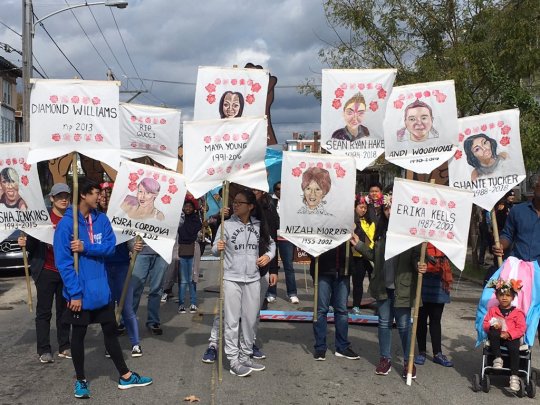
A participatory culture was originally defined by Jenkins as one:
- With relatively low barriers to artistic expression and civic engagement
- With strong support for creating and sharing one’s creations with others
- With some type of informal mentorship whereby what is known by the most experienced is passed along to novices
- Where members believe that their contributions matter
- Where members feel some degree of social connection with one another (at least they care what other people think about what they have created)
Researching participatory cultures over time – through fan communities and activists movements primarily – Jenkins and Sangita Shresthova have been interrogating the possibilities and challenges through the Civic Imagination Project where “imagining community … is actively generating new cultural symbols to describe their relationship with each other. Imagination is seen not as a product or a possession … Rather, we talk about imagining as a process.”

Supporting imagining as a process and creating new signs and symbols through sharing stories are core ideas of the Spiral Q Puppet Theater. Through low-stakes and accessible object creation and performance, participants can make and remix their everyday reality alongside others. In its mission statement, Spiral Q states that “We imagine a city whose streets reflect the full spectrum of its residents’ creativity. We see a responsive and engaged society that rallies consistently to overcome the challenges of discrimination and oppression. We envision a world of abundance that mobilizes its resources to nurture shared vitality.” When sharing the power of the 2019 Peoplehood Parade and Pageant, co-director Jennifer Turnbull describes the process that surfaced the story and related puppets:
This year we partnered with three local grassroots activist groups …. Through pageantry we were able to show the through line connection they all had to health, housing, self determination and freedom.
In working to design for shared power and participation, Tracy Broyles – the Director of the Q after Matty – describes the ways that affirmation, imagination and practice are so important. Everyone has a role to play, she says, and that “any moment someone enters the process is the right moment” (TEDx Philly, 2012). Affirming participation, and providing many points of entry, are key ways that the Q attempts to build Peoplehood and, according to Jenkins, are defining features of participatory practice.
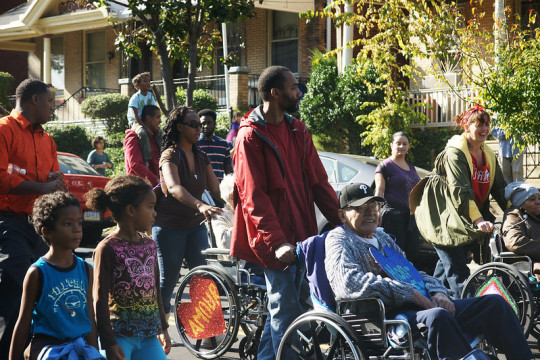
Another central element of participation, according to Jenkins, “is that we participate in something larger than ourselves, however we want to imagine what it is we are participating within” (Jenkins, Confessions of a Aca-Fan post, 2019). Eli Nixon, in 2003, describes themselves and this work as part of a larger whole:
I’m just a small column of flesh and bones. I can build something that’s larger than me… I really get a kick out of it as a way to tell stories and to make humans bigger than they are or to examine different parts of everyday people’s lives in a way that I think is more interesting than real life. It’s an awesome way to interpret who we are.
Looking at the outcomes of a participatory process is another way to assess its viability (Jenkins, Confessions of a Aca-Fan post, 2019). Tracy describes the ways that people literally “spiral out of q.”
What we see is this a place where people test these things and then go out into the world. Okay so now [they] might not use puppets and art and all these things … but they have got this place, a sense of direction, a sense of safety, a sense of community has formed around that individual or that community and then that cause or idea … can really gain some traction and go off and become a movement that’s working on a policy level or at a community organizing level or simply building beautiful things.
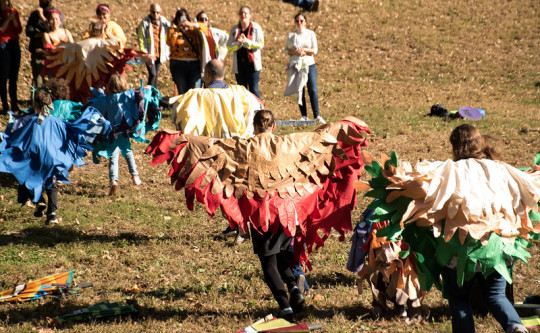
In working to refine a definition of participatory culture in a fractured media environment, Jenkins and his colleagues bring a critical focus to the mix, ie. “Which members of a dis-privileged group find their power position strengthened through the participatory process?” A complex question but also critical for the Q. In one example, we find an interview 2003 with Jennifer Hilinski, a therapist at Girard Medical Center, who was asked about her experience working with a group of men in recovery in collaborating with the Q on Peoplehood the previous fall.
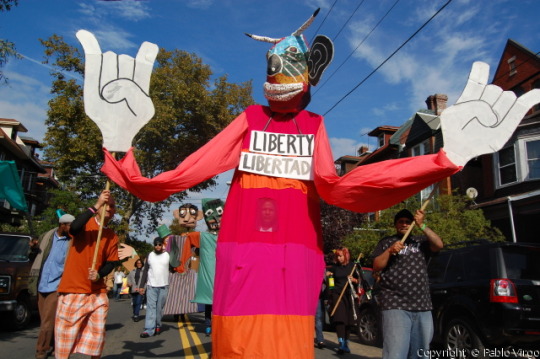
“The common story was about recovery and getting back into the real world as contributing members of society.” Jennifer said, “And they took a theme of going from hell — which was the streets and using — to this kind of angelic transformation and re-entering the world and the streets but not as street person” (2003). Since that time a group from Girard Medical Center participate in Peoplehood every year, leading with their giant backpack puppets of transformation.
Conclusion
In the 2008 Peoplehood newsletter, the process of building Peoplehood is described by Tracy as “flawed, just like our democracy.” And we are reminded by the Civic Imagination Project that “If stories can inspire and empower social change, stories can also shatter communities, feeding our fears and suspicions, re-enforcing stereotypes in particularly vivid ways.” Jenkins and his colleague also tell us that the fostering of participation is vital while fragile and requiring care:
participation could also be finished. It could come to an end. Democracy, as a political and social practice, is not a given, but could cease to exist. … This is why participation and democracy need to be actively protected, and not just silently appreciated.
We know that object performance, storytelling, or even parades and pageants which historically have also been used in fascist and authoritarian settings, do not create democratic space themselves. Instead democracy, through an ethos of participation, needs to be fostered.
Peoplehood, as a creative space for democratic storytelling and cultural remixing, is one such opportunity to intentionally test and tinker with the possibilities and challenges of participatory practice. It allows individuals and groups to come together, figure out what is needed when they work together, and then bring it into being through object creation, puppet performance and joyful demonstration.
In 2003, Matty Hart described Peoplehood’s parade and pageant as “secular cultural ritual[s] … that are actually really kind of sacred and really really old.” These rituals, when built in shared and participatory ways, situate puppets and objects as powerful vehicles for fostering civic imagination through the creation of new cultural symbols and understandings.
As Jennifer writes about the Q in a Nonprofit Executive Leadership Institute
newsletter: “we create space for the unknown. You just don’t know what you don’t know.”

Want to read more about Peoplehood and Spiral Q? Check out Part 1: What is Peoplehood? and Part 2: Elements of Performance.
Images courtesy of spiralq.org and my personal collection.
 Productive Language Studio
One thought on “Spiral Q Peoplehood and Participatory Puppet Performance, Part 3”